
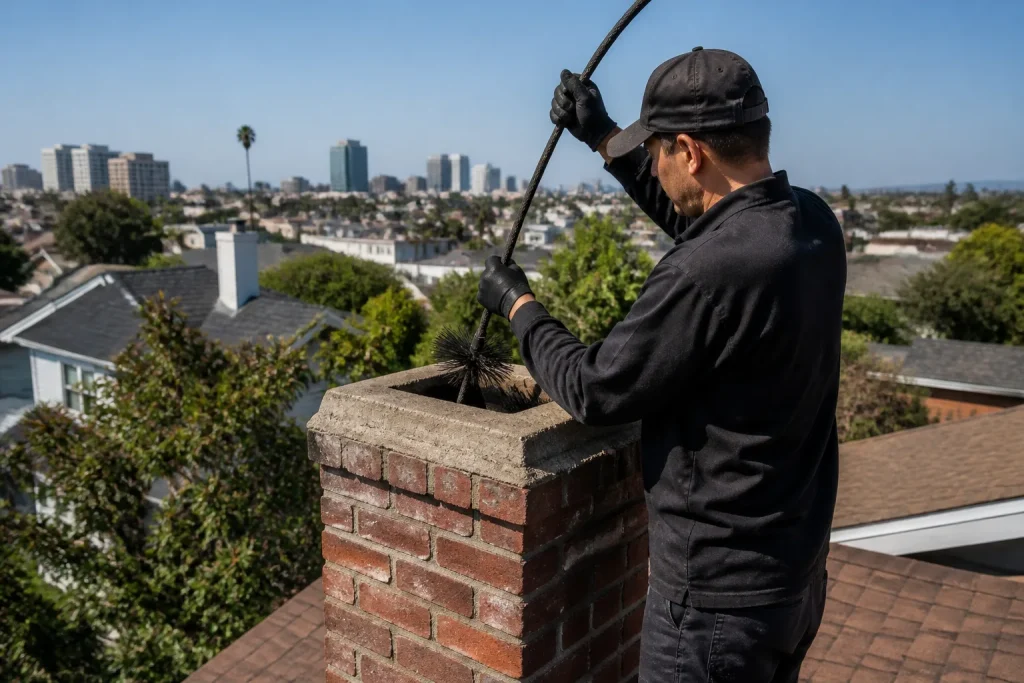
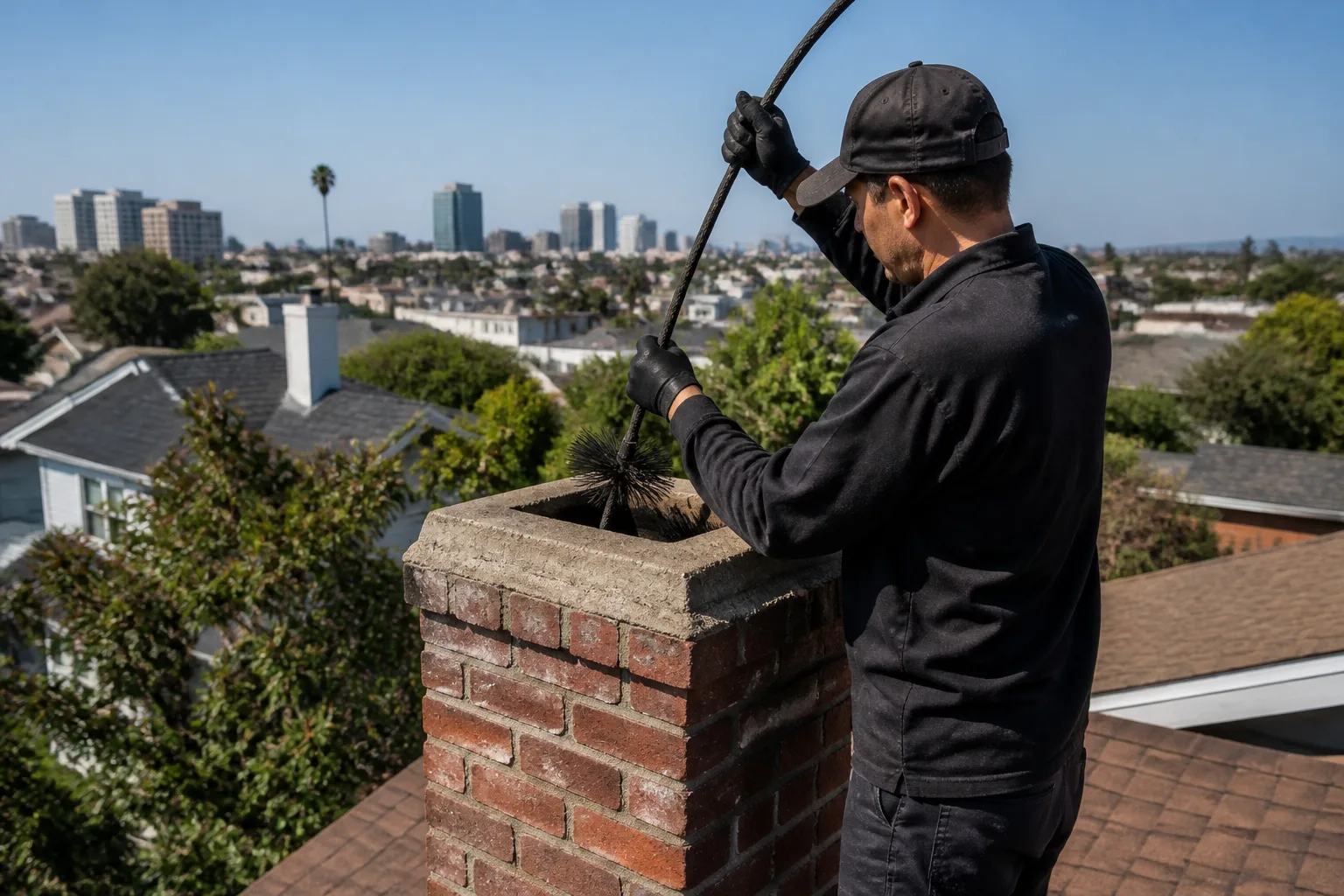
DuraFlex Chimney Sweep in Downtown Anaheim: A Homeowner’s Guide
DuraFlex isn’t a cleaning product. It’s a corrugated stainless steel liner system, installed when the terra cotta flue tiles inside a chimney are cracked, offset, or simply the wrong size for the appliance attached to them. Homeowners who confuse a liner job with a sweep end up paying twice: once for a cleaning that couldn’t fix the problem, and again for the liner they needed all along. If you’d rather not sort that out yourself, call (855) 658-5274 and we’ll inspect first, recommend second.
What Is DuraFlex, Exactly?
DuraFlex is a flexible stainless steel chimney liner. It arrives as a coiled length of corrugated tube that gets fed down the flue, which is why it can follow a chimney that bends or offsets rather than running dead straight. Rigid liner sections can’t do that. A straight flue takes rigid pipe fine, but plenty of chimneys in Downtown Anaheim’s older houses were built with a jog in them, and a flexible liner is what threads through without demolition.
The alloy grade is the part homeowners rarely ask about and probably should:
- Wood-burning appliances generally call for a higher grade of stainless, because wood smoke and creosote are the harshest things a liner will meet.
- Gas appliances produce different condensate chemistry and often suit a mid-grade alloy.
- Oil appliances have their own corrosion profile and need a liner matched to that fuel.
Get the grade wrong and the liner can fail years earlier than it should. That’s the whole reason a liner isn’t a one-size purchase. We work with DuraFlex, HeatShield, Famco, and Copperfield systems, and matching the alloy to the fuel is the first decision on every liner job we quote.
Why DuraFlex Installations Are So Common in Downtown Anaheim
Downtown Anaheim has a housing stock that runs from craftsman bungalows to mid-century builds, and both bring liner problems to the table. The older craftsman homes were built with terra cotta flue tiles, a material that holds up well until it doesn’t. Decades of heating and cooling cycles crack the tiles, and mortar joints between them crumble. Once the tiles crack, the flue is no longer contained, and that’s a safety problem, not a cosmetic one.
The mid-century houses add a second wrinkle: gas insert conversions. When a wood fireplace gets a gas insert dropped in, the original flue is usually far too large for the new appliance. An oversized flue lets the exhaust cool before it exits, which causes poor draft and condensation inside the chimney. Sizing a liner to the insert fixes both. We’ve seen plenty of both situations in Downtown Anaheim, and neither one gets solved by sweeping alone.
Then there’s the third case: chimneys with no liner at all, common in older homes built before liners were standard. Those are the ones we flag fastest during an inspection.
The Installation Process, Step by Step
Understanding the sequence helps you ask better questions when you get a quote.
- 1
Level 2 camera inspection. This always comes first, and no liner gets ordered until it’s done.
- 2
Sizing to the appliance. The liner is matched to the appliance’s BTU output and the flue’s height and shape.
- 3
Cleaning the flue. The existing flue gets swept clean before anything goes in.
- 4
Threading the liner. The corrugated tube is fed down through any offsets in the chimney.
- 5
Connecting the appliance. The liner is joined to the appliance collar with the correct adapter.
- 6
Terminating at the crown. The top is finished with the right cap and a proper termination.
- 7
Insulation where needed. Some installations call for an insulated wrap to protect draft and reduce heat transfer.
Step one is not negotiable. A liner ordered before the inspection is a liner ordered on a guess. Camera inspection shows what the flue actually looks like from the inside: cracked tiles, gaps at offset joints, prior liner remnants, and the true dimensions. On any chimney sweep visit where a liner is even a possibility, the camera goes down.
What the Inspection Is Looking For Before Any Liner Is Ordered
A Level 2 inspection is the linchpin of the whole job. Here’s what we’re actually checking:
- Terra cotta condition. Cracks, spalling, and missing mortar joints between tiles.
- Offsets and bends. Where the flue jogs, and how sharp the angle is, since that determines whether a flexible liner can pass.
- Flue dimensions. Measured, not guessed, because liner sizing depends on it.
- Existing liner remnants. Old liners that need removal before a new one goes in.
- Creosote buildup. Heavy glazed creosote may need treatment before a liner is installed.
- The crown and cap. If the top of the chimney is letting water in, the liner job will be undermined by moisture.
That last point matters more than people expect. A liner protects the inside of the flue, but the chimney cap & crown protects everything from above. If the crown is cracked, water gets into the chimney structure and no liner fixes that. We often address the crown alongside the liner on the same visit, since a water-damaged crown will eventually undermine the liner’s protection.
What to Expect After a DuraFlex Liner Is In Place
A properly installed DuraFlex system changes the maintenance picture, but it doesn’t eliminate maintenance.
Long-term performance. A stainless liner is designed to outlast terra cotta by a wide margin. It carries a manufacturer’s warranty, and the terms vary by product and installation, so read them on your written quote rather than relying on a verbal promise.
Annual maintenance. The liner still needs an annual sweep and inspection. Creosote still accumulates inside a liner just as it did inside the tiles; the liner simply contains it safely and channels draft properly. Skipping yearly sweeps is how a healthy liner turns into a blocked one.
What to watch. Draft that seems weaker than it used to be, smoke rolling back into the room, or moisture in the firebox after rain all warrant a call. So does any change to the appliance itself, since swapping appliances means re-checking the liner.
A clean flue is a safe flue. But Chimney Sweep Downtown Anaheim works on the idea that a sound chimney keeps it that way. The liner and the crown and the firebox all have to hold together as a system.
When to Call a Pro
If you’re considering a DuraFlex installation, the smartest first move is the inspection, not the liner order. And a few situations genuinely belong in a professional’s hands:
Any chimney with visible cracked tiles inside the firebox, a firebox that’s pulling away from the surround, or draft problems after a gas insert conversion needs eyes on it. So does a firebox with damaged brick or mortar; that’s fireplace repair territory, and it comes before a liner. And anything involving the flue’s interior surface is work we don’t recommend a homeowner tackle. Camera inspection is what tells you whether you need a liner at all, which is the honest starting point before any product gets ordered.
The Bottom Line
DuraFlex is a flexible stainless steel liner system, matched to the appliance, installed only after a Level 2 camera inspection confirms the actual condition of the flue. On Downtown Anaheim’s older craftsman and mid-century homes, the common triggers are cracked terra cotta tiles, offset flues, gas insert conversions, and chimneys with no liner at all. If you’re weighing a liner job against a simple sweep, get the inspection first. The liner is worth the money when you need one and worth skipping when you don’t, and camera evidence you can see for yourself is how that decision gets made honestly.
If you’re in Downtown Anaheim and need help, Chimney Sweep Downtown Anaheim offers free estimates. Call (855) 658-5274. We answer 24/7. Fast dispatch from 7am to 7pm, Sunday through Friday. Our technicians have up to 10 years of experience, and the estimate is free.
Frequently Asked Questions
Does a DuraFlex liner replace the need to sweep my chimney?
No. A DuraFlex liner contains the flue and improves draft, but creosote still builds up inside it, so the annual sweep and inspection still apply. Call (855) 658-5274 for an exact quote on a sweep or inspection. Estimates are free.
How do I know if I actually need a DuraFlex liner?
A Level 2 camera inspection is the only reliable answer. It reveals cracked terra cotta, offset joints, missing tiles, and flue dimensions, which is what determines whether a liner is needed and which product fits. We recommend nothing without camera evidence you can review yourself. Call (855) 658-5274 to book the inspection.
Can a DuraFlex liner be installed through an offset flue?
Yes, an offset flue is exactly what a flexible corrugated liner is built for, because it can follow the bend that rigid pipe sections can’t. The inspection confirms whether the angle is workable before a liner is ordered. Call (855) 658-5274 to find out where your chimney stands.
What happens if I skip the liner and just keep sweeping?
Sweeping removes creosote buildup, but it does not repair cracked terra cotta or close gaps between tiles. Those conditions leave the flue uncontained, which is a safety issue a sweep cannot solve. If the inspection shows damage, the liner is the fix; if it doesn’t, you’re clear to keep sweeping. Call (855) 658-5274 for an honest assessment.
Written by the team at Chimney Sweep Downtown Anaheim.
Need Chimney Cleaning Help?
Call Chimney Sweep Downtown Anaheim - the local pro we connect you with is licensed and insured, with free written estimates in Downtown Anaheim.
(855) 658-5274